Improperly tensioning a timing belt at installation is one of the most common causes of timing belt problems, leading to issues ranging from tooth skipping to tensile fatigue, and in some cases complete belt failure.
To maximize a drive’s performance and lifespan, proper tension is essential. In this guide, we break down the importance of timing belt tension, three ways to measure and set pretension, and adjustments to make to get the tension right.
Timing belt tension is critical to achieving optimal performance and getting the most out of a drive. An improperly tensioned timing belt often results in increased noise, precision loss, accelerated wear, and can cause timing belts to break. In short, if a timing belt isn’t tensioned correctly, it likely won’t work the way it needs to.
When people discuss timing belt tension during installation, maintenance, or troubleshooting, they are usually referring to the initial pretension, which is the tension applied when a belt is installed, or static tension, which is the tension when the belt is not moving.
Pretension significantly influences how a belt behaves under load, so issues with the operating tension can sometimes be addressed by adjusting static tension.
Measuring timing belt tension is a critical step in installing a timing belt. There are three main ways to measure static tension of a timing belt:

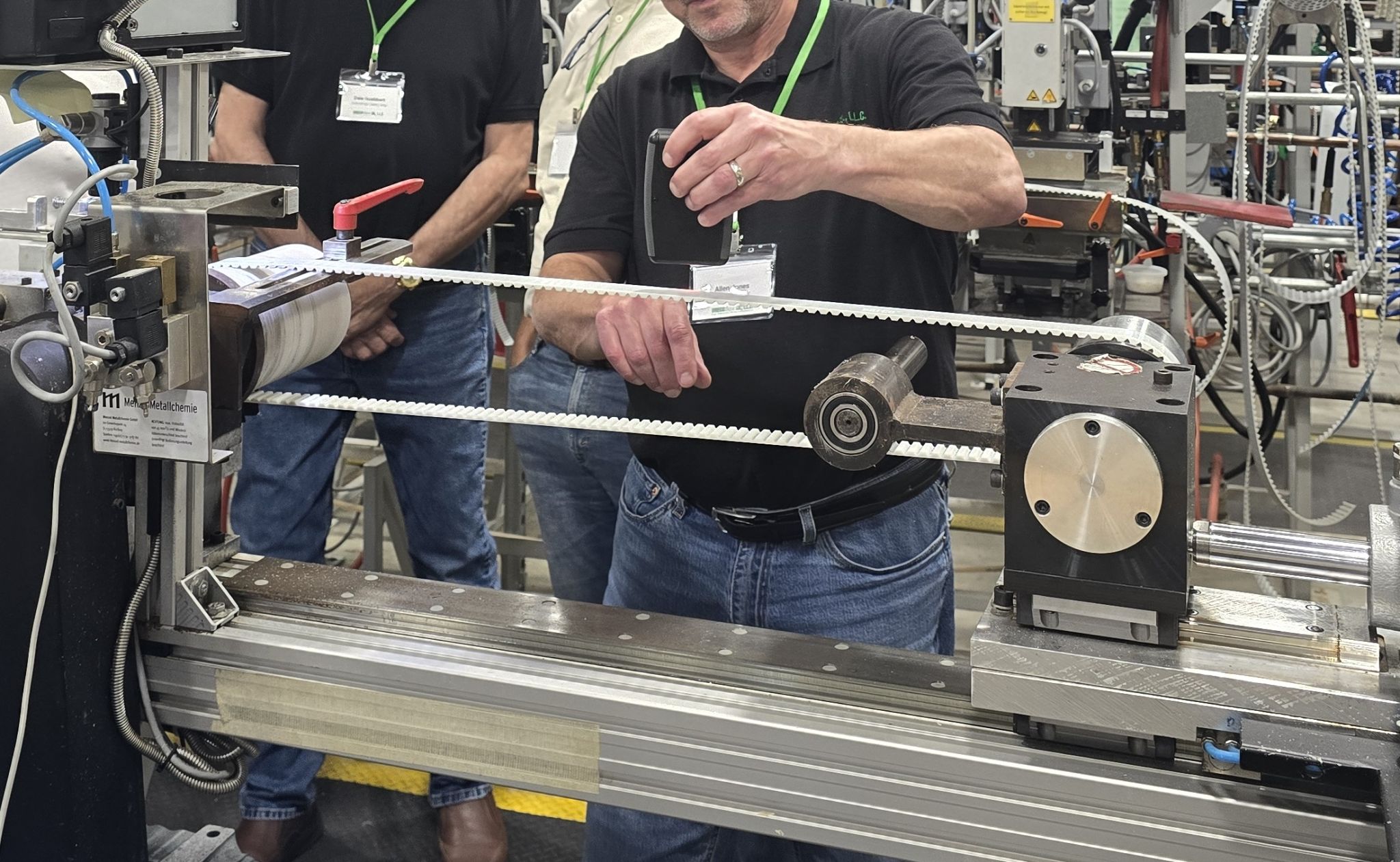
The SM5 Tension Meter is the easiest and most accurate way to measure and set belt tension. The sonic belt tension meter measures the frequency of belt vibration, which can be used to calculate the current static tension using the formula below:
![The formula used to calculate static belt tension: Fv = f2 • L2 • 4 • m • b Fv [N] current pre-tension in Newtons (1lbf = 4.45N) f [Hz] frequency read from the meter L [m] free vibrating span length in meters m [Kg/m/cm] belt mass in kilograms per meter of length per centimeter belt width b [cm] belt width in cm (1” = 2.54cm) (1cm = 10mm)](https://cdn.prod.website-files.com/6321faa31729834cada9ee26/6a32ab9dd8dd6f4b193b1451_Static%20Tension%20Formula.png)
If you already know the pretension value you need to achieve, you can use that to calculate a target belt frequency measurement and compare that to the reading on the meter using the following formula:
![The formula used to calculate target frequency reading: f = √(Fv / (L² · 4 · m · b)) Fv [N] target pre-tension in Newtons (1lbf = 4.45N) f [Hz] frequency reading L [m] free vibrating span length in meters m [Kg/m/cm] belt mass in kilograms per meter of length per centimeter belt width b [cm] belt width in cm (1” = 2.54cm) (1cm = 10mm)](https://cdn.prod.website-files.com/6321faa31729834cada9ee26/6a32abf808bc5301262b5444_Belt%20Frequency%20Formula.png)
When you use the SM5 Tension Meter, you can pair it with our free SM5 Pretension Calculator App that performs calculations instantly, eliminating the need to manually complete complicated formulas or reference external charts.
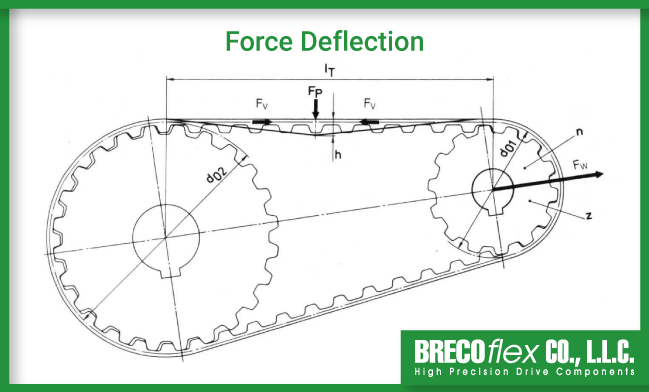
Tension can also be measured by performing a force deflection test, in which force is applied to the center of the belt span, and the deflection distance is measured.
The force and deflection measurements can then be used in a series of calculations or compared to specifications provided by the belt manufacturer to determine if the belt is over or under tensioned. Our Applications Engineering team can provide details and formulas when required to assist with force deflection measurements.
Force deflection tests are typically done using a pencil force gauge to get an understanding of how much force is applied to the belt. However, even with a force gauge, this method is not as accurate as using a sonic belt tension meter.
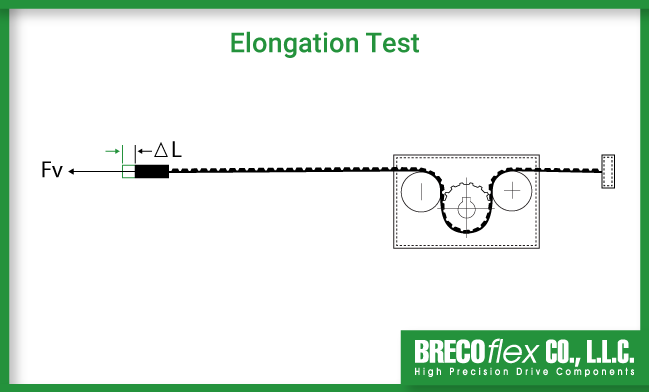
Elongation tests can also be used to determine belt tension, which is typically used for longer belt spans or linear drives. When a belt is tensioned, it stretches slightly. By identifying how much a belt should elongate with proper tension, you can get a general idea of how to install the belt.
An elongation test for belt tension starts by measuring the belt span and calculating the estimated elongation under proper tensioning, which varies by tension member material.
Once you have the elongation distance calculated, you can install the belt by marking the tensioner and a fixed point with the appropriate distance and moving the tensioner by that distance.
Like force deflection tests, elongation tests are not the most accurate method for measuring belt tension, especially when compared to using a tool like the SM5 Tension Meter.
There are a few different ways to adjust pretension when a timing belt needs more tension:
If a timing belt has too much tension, try adjusting clamps and the position of any tensioners or decreasing the pulley center distance, if possible. In some cases, an over-tensioned belt could indicate that the belt is too small for the application, and a new belt is required.
An over-tensioned timing belt can lead to wear, noise, and increase the risk of failure. Here are a few common timing belt symptoms that may indicate that tension is too high:
When timing belt tension is too low, it can cause damage to drive components and impact overall performance.
Many timing belt issues are the result of improper installation, not the belt itself, which is why it’s so important to get the pretension right from the get-go. Otherwise, you run the risk of premature wear, diminished performance, and shortened lifespan, all of which will cost you time and money in the long run.
The easiest and most accurate way to measure static belt tension is with the SM5 Tension Meter, which can be used across belt types, regardless of tension member material. Other tests, like the elongation or force deflection methods, can also be used to measure timing belt tension but are far less precise than using a sonic belt tension meter.
The correct pretension for a timing belt depends on the belt and drive design. If you’re unsure of the correct tension and frequency values for your system, you can contact our Application Engineers for free tensioning support.